Friday, May 12, 2017
Surfing in Africa
Penguins!
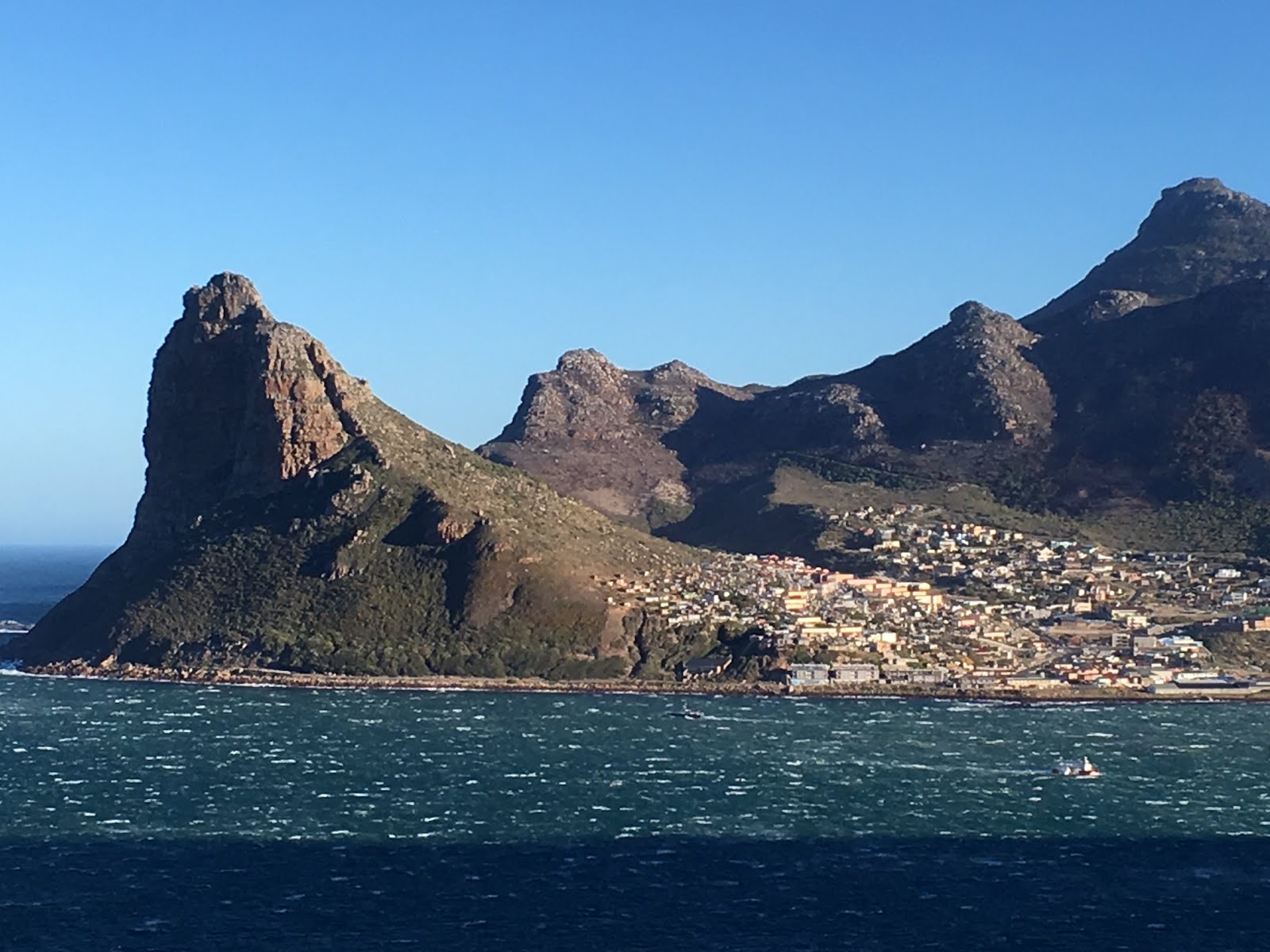
The Cape
Here are some photos of the drive:
Day 19 - May 11th 2017 - The South African econony
We spent this morning visiting two different institutions and learning about the South African economy. Investec is a large investment bank and our agent Stephen had set up a talk with Brian Cantor, who according to Stephen, is one of the most important economists in Africa. Brian had just published a book titled How to Get Africa Growing Again and although Investec is mainly a wealth and asset management firm, the talk at our request, focused on macroeconomic and growth constraints faced by the economy.
The thrust of Brian's arguments were that the South African econony is burdened by excessive regulations, especially in the labor market, and that preferential racial treatment and the heavy welfare state won't lift the majority of the poor out of poverty in a sustainable way since the youth unemployment rate is close to 50%. He believes that the economy needs to be more liberalised and focus on growth which will result in job creation and a more long-term solution to the poverty issue.
We then visited The Free Market Institute which as the name suggests is an economic think tank focusing on economic liberalisation as well. We were greeted by Temba Nolutshungu, the director of the Institute, who spoke to us for almost an hour about his vision for how best to solve the problems facing the South African economy including slow growth, high unemployment, poverty and income inequality. For the most part Temba echoed many of the same points as Brian , with a more extreme focus on liberalisation and the removal of barriers and regulations which hinder free enterprise. His beliefs were firmly rooted in the power of the free market as the engine of economic growth and poverty reduction. He even gave us a critique that he had published of Thomas Piketty's Capital in the 21st Century which is peppered with criticisms of socialism, Marx and the welfare state (I wish I had a fire extinguisher to put out the smoke coming out of Martha's ears : ).
As an economist, for the most part I agreed with many of the basic precepts expressed by them on deregulation and liberalisation. However, I also believe that the unfortunate legacy of apartheid has left many systemic and structural imbalances in the country which need to be addressed by a more focused development policy before the gains of economic growth can trickle down to the lowest echelons of society. The unequal distribution of human capital (health and education) is one of the most glaring causes of the current disparities in income distribution. However, when pressed on these issues with questions Temba and to a lesser extent Brian, continued to stress economic liberalisation as the only path forward with no complementary development policy.
I was proud of our students who focused intently on what were two fairly long and academic discussions and asked pertinent questions of both speakers. We were quite privileged to have gotten these oportunities as they are both important and high-ranking individuals who went through considerable trouble to take time to meet with us. We learned a great deal and kudos to Stephen for setting this up for us!
Thursday, May 11, 2017
Cape Malay cooking in the Bo Kaap
Our visit was so we could learn about cooking. Cape Malay food is really very distinct from more traditional South African fare. Our host was wonderful and very friendly, welcoming us into her home where we packed in around the counters in the kitchen. She was showing us how to make several traditional dishes: chicken curry, rotis that we buttered and rolled and smacked into shape before frying, samoosas filled with chicken or vegetables before being sealed and folded tightly into small triangles and fried, and what she called chili bites (fried dough balls made with chick pea flour, onion, and spices). We all got a chance to try making these dishes before everything was cooked up and eaten. And eaten. Yum!
Wednesday, May 10, 2017
Day 17 - May 9th 2017 - Khayeltisha's Dynamic Entrepreneurs
We spent the day visiting different projects in Khayelitsha, Capetown's largest township. Martha has already written about the beginning and end of our day. Sandwiched in between, we spent the afternoon visiting two young African entrepreneurs both of whom had won competitions and obtained financing for their ideas.
The first was Iyeza Express which started out as a medicine delivery company. Public hospitals in South Africa are extremely inefficient with long queues for everything including picking up medicine that chronic sufferers might be taking on a daily basis. One can spend all day in hospital just to see the doctor or pick up a prescription. One bright, enterprising young man experienced this everytime he went to pick up meds for his diebetic grandmother. He saw an opportunity and offered to pick up meds for his neighbor for a small fee. His neighbor jumped at the offer and passed the word around and soon people were calling him and asking him to pick up their scrips. His business slowly grew until be hired more people to do deliveries for him and he now has five couriers on bikes delivering all over the township.
The second and more lucrative branch of his business now includes a self-testing rapid result AIDS kit called I-Test which he has partnered with a pharmaceutical company to brand and distribute. South Africa has one of the highest rates of HIV prevalence and infection rates in the world and there is still a social stigma associated with being HIV postive. The hospitals are set up with little regard for privacy and thus many people don't get tested. I-Test allows people to determine if they are HIV positive in the privacy of thir homes. In addition, if negative, it then allows them to take Prep which is an HIV prevention drug also distributed by Iyeza. I joked with him that I suspected that he would be able to retire in two years. He is only 24 years old.
Out next visit was to The Spinach King , who Bailey and Donato had been looking forward to meeting since before we left the US. The Spinach King had a similar story to Iyeza. In an effort to incorporate and bring more awareness of a healthy lifestyle and better nutrition, the Spinach King began baking gluten free spinach bread, and using the local grocery store chain to distribute it as well as door to door delivery. As his business grew he built his first brick and mortar location and now has a second branch which is the one we visited.
He also met Richard Branson and Virgin Active (a large fitness chain owned by Virgin) built him customised spin bikes that can be hooked up to make smoothies while you bike. Thus the emphasis on exercise and healthy eating in one shot. We sampled his spinach smoothies and spinach bread all of which were tasty. We were also entertained by a song which had been prepared just for this occasion, sort of like a Spinach King jingle.
It is quite exciting to see these examples of enterprise flourishing and renews my belief in the essence of the market system. One thing I have noticed is that people here are generally so vibrant, positive and friendly. Even the scores of migrants from impoverished African countries who have made their way here and are earning a living by selling crafts in the market place. Martha and I have spent time wandering around the arts and craft markets and chatted with people from Congo, Mali, Malawi, Senegal and many others. Even though they pitch a hard sell and we bargain , at the end they call us their sisters and give us hugs before we leave. They are all supporting families back in their home countries and let's just say that we are doing are best to help them out : ). Students have been visiting these markets as well. In fact our hotel opens out onto the main market square, so when they bring back their crafts and souvenirs , you should know that their purchases have helped families in need all over the continent. The best kind of gift!!
I'll end on an update for the families. Wednesday May 10th is our free day and the entire group with the exception of one had planned to go shark-cage diving. We just found out that it had been canceled because their are killer whales in the water that have driven away the great white sharks (yes great whites are not the top of the food chain!) and it is too dangerous. Understandably students were dispointed and have had to make alternate plans. About half of us are going Para-gliding for part of the day. I'm sure you'll hear about how they spent the day from your kids.
Tuesday, May 9, 2017
Baphumelele House
We had stopped earlier in the day at a grocery store where we bought a bunch of corn meal, beans, rice, onions, fruit, milk packs, and cooking oil. This was our donation, which we hauled in off the bus and piled on a table in the small main office. And then...we went to the baby room! It was literally a room full of adorable babies! These are the orphans and abandoned children who live there, and these were the youngest of the bunch. There were 11 of them, and they wanted hugs, and patty cake and they wanted to touch our cheeks and grab our hair and they were generally the cutest babies in the world. They are obviously well-fed and well-loved, and they were--all of them--very social, which suggests they get a lot of loving visitors. Their room was small, with a tile floor and an 8 by 10 area rug. There were colorful murals on the walls, and severals small bedrooms with 5-6 cribs in them. It was not a fancy place, but it seemed like a happy place. As we left, one baby broke free and toddled/ran after us for about 50 feet before being scooped up by a worker. I'm pretty sure that it was just as hard on us to say goodbye as it was for that baby!
I'm not posting photos here, for privacy reasons, but I suspect the baby room was the highlight of the day!